Seven Days of Plank: A Quiet Diary
Active Living · The Personal DiaryA reader wrote in January and asked, gently, whether I had ever actually done a plank every day for a week. I had not. I had recommended the drill in passing for years, the way you might recommend a restaurant you have only walked past. So I unrolled the mat and tried to atone. This is what happened.
Day One: A Surprised Wobble
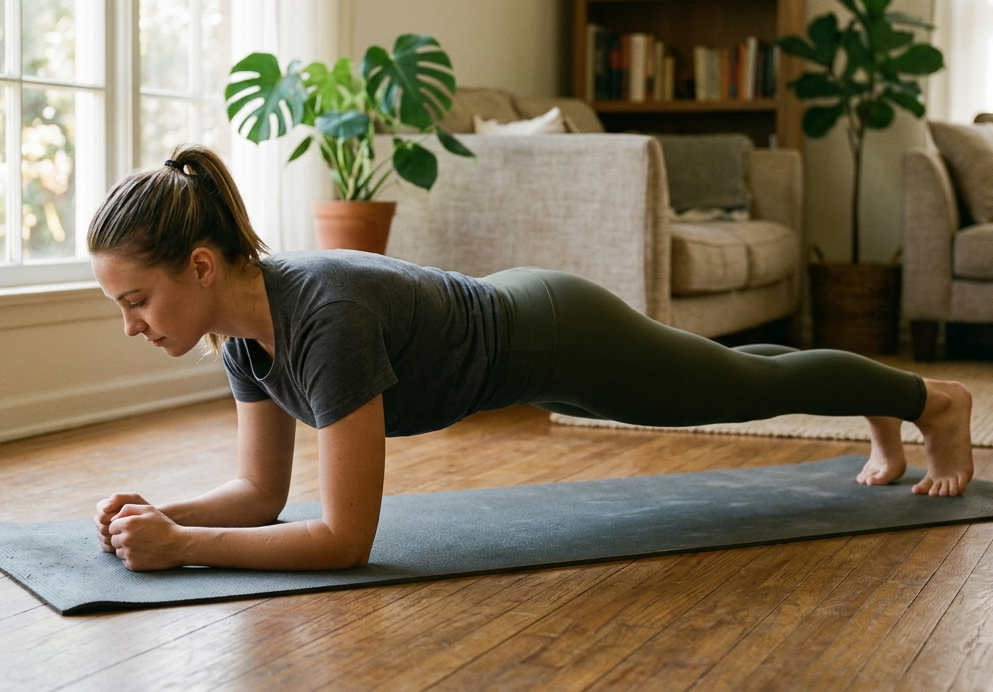
I set my phone’s timer for thirty seconds. According to a Harvard summary of beginner-strength guidance I had read the week before, thirty seconds is a reasonable starting hold for an adult who has not done this before. I expected it to be uneventful. By second eighteen my left hip had developed an opinion about the angle of my pelvis, and by second twenty-six I was shaking. I finished, panted, drank water, and felt mildly betrayed.
Day Two: The Wrists Speak Up
I learned, on day two, that I had been resting on the bones of my wrists rather than the soft muscle of my forearms. I switched to a forearm plank and the wrists stopped complaining. The shoulders, who had been quiet on day one, joined the conversation instead. Generally promotes humility, this drill.
Day Three: The Quiet Pleasure of Knowing
Something small happened on day three. I unrolled the mat without negotiating with myself. The thirty seconds, this time, felt only mildly impossible. I held for thirty-five before lowering, and was surprised by how proud the extra five seconds made me. In my experience, this is the point where a practice begins to belong to you.
Do
- Start with achievable holds, not aspirational ones.
- Switch between palms and forearms based on wrist comfort.
- Look at the floor, not the wall in front of you.
- Breathe slowly through the nose throughout.
- Rest a full day if anything is sharp or pinching.
Don’t
- Hold your breath for the entire plank.
- Sag the hips toward the floor.
- Lift the hips into a pike to make it easier.
- Compete with yourself on day three for day six’s number.
- Push through sharp sensations in the lower back.
Day Four: An Honest Stall
Day four, in retrospect, was where most of my previous attempts at this kind of streak had collapsed. I was busy, the morning got away from me, and at 8 p.m. I had not yet planked. I unrolled the mat anyway, in my pyjamas, while the kettle boiled. Thirty-eight seconds. I rolled up the mat and went to bed. This, I think, is the day the project succeeded.
“Consistency is not the absence of resistance; it is the small, honest negotiations with resistance,” a colleague who writes about behavioural science told me, and I have stolen the sentence shamelessly.
Day Five: A Side Plank Experiment
Confident, perhaps too confident, I added a side plank to each side. Fifteen seconds left, fifteen seconds right. The right side was noticeably weaker, a fact I now think most people would discover about themselves if they tried. I held the forearm plank for forty seconds at the end, less from ambition and more from curiosity.
Day Six: The Mind Settles
By the sixth day the drill no longer felt like a chore. The forearm plank was forty-five seconds, slow breath, gaze on the rug. I had stopped staring at the phone timer. Time, it turned out, was an ally now rather than an opponent. WHO specialists, in their writing on the benefits of small daily routines, frequently note that the psychological reframing of effort is often more durable than the physical change. I felt the reframing happen in real time.
Day Seven: Quiet Conclusion
The final day was anticlimactic in the best way. I did fifty seconds, with two short side planks, and rolled up the mat with the same unceremonious quiet I had unrolled it with. There was no triumphant finish. There was a mild improvement and a permanent willingness to try the drill again on any given Tuesday. I think this is what people mean when they say a habit has taken.
Frequently Asked
Did anything change physically?
Generally helps with how my torso felt during long sitting. The shaking-out reduced. The lower back felt steadier. I would not promise dramatic results from a week.
Should I attempt a daily plank?
If you are well, yes. Start at a hold you can complete with steady breathing. Stop if anything sharp shows up. Consult a qualified specialist if you have any concerns.
Does the time of day matter?
In my experience, no. The best time is the time you can repeat. Mine ended up being late evening, near the kettle, beside the cat.
What comes after a plank week?
I added two more days the following week, then took the streak less seriously and folded the plank into the rest of my home routine.
Try a Guided Week with Us
Sign up for a free seven-day plank programme delivered as one short email a day.
Sign up for a training sessionSubscribe to the Gazette
One short letter, every Saturday morning.
Read Also
How to Warm Up During Phone Calls
Quiet drills you can do without anyone on the other end knowing.
How to Talk Yourself Into Exercising at Home
Small psychological tricks that keep a routine alive.
A Buyer’s Guide to Fitness Mats
On the small details that turn a mat from disposable into beloved.
How to Talk Yourself Into Exercising at Home: The Psychology of Showing Up
Active Living · The Mind Behind The MovementMost of us, in my experience, do not have a fitness problem. We have a starting problem. The hardest minute of any home routine is the minute before the mat unrolls. I spent the first three years of my own at-home practice losing to that minute. What changed was not my willpower — my willpower remains negotiable — but my understanding of why the minute is so loud and how to make it quieter.
The Honest Read: It Is Not Laziness
The word “lazy” is one of the least useful in our vocabulary. According to research summarised by Harvard’s health publications, what we call laziness is usually a combination of decision fatigue, ambiguous goals, and a kind of social loneliness that is hard to admit. The living room is a quiet place. There is no class waiting, no teacher counting, no one to disappoint. The mind naturally drifts toward easier rewards.
Once I stopped calling myself lazy and started calling myself under-cued, my whole relationship with at-home movement changed. The job became environmental, not moral.
The Five-Minute Rule and Why It Works
The single most useful psychological trick I have stolen and kept is the five-minute rule. The agreement I make with myself is small: I will roll out the mat and move for five minutes. I am allowed to stop after exactly five minutes if I still want to.
“Behaviour responds more reliably to small, repeatable cues than to large, infrequent intentions,” researchers at Harvard’s behavioural science unit have written in summaries of habit research.
I almost never stop at five minutes. The point is not the five minutes. The point is that the door into the room of movement has been pushed open. In my experience, the resistance is at the door, not in the room.
Environment First, Motivation Second
If you have to dig your mat out from behind the winter coats, you will not exercise. This is not a personal failing; it is the geometry of the home. I now keep my mat permanently leaning against the wall by the kitchen door, where I cannot miss it. A small set of resistance bands lives in a wooden bowl beside the kettle. The kettlebell sits, somewhat absurdly, on the floor under the coat rack. The home is dressed for movement before the day starts.
Do
- Pick a permanent visible spot for the mat.
- Choose a fixed weekly anchor (e.g. Tuesday after the kettle).
- Write the five-minute promise on the fridge.
- Lay out clothes the night before, even if you sleep in.
- Keep a one-line journal of how each session ended.
Don’t
- Plan a perfect hour-long programme on Sunday night.
- Hide equipment in cupboards or under beds.
- Compare today’s session to your best one.
- Negotiate with yourself in bed before getting up.
- Punish yourself for missed days.
Anchors: How to Tether a Habit to Something Already Stable
Habit research, much of it neatly summarised by the public health team at Harvard, repeatedly finds that new behaviours stick best when anchored to existing ones. My own anchor is the kettle. When the kettle goes on for the second time after lunch, the mat unrolls. This works because the second kettle is, in my home, biologically reliable. It happens with or without my consent. The movement now rides on top of it.
Find your kettle. It might be the dog’s afternoon walk, the start of the lunch news, the moment the kids leave for school. It does not need to be aspirational. It only needs to be stable.
The Sunday Evening Slump
Readers wrote to me throughout March about a very specific kind of resistance: the Sunday-evening one. They knew the week was about to start. They knew Monday would be the day they returned to their routine. And the closer Sunday’s end crept, the less likely Monday seemed. I recognise this slump intimately.
What I now do on Sunday evening is something almost laughably small. I lay out my workout clothes on the chair beside the bed. I unroll the mat in advance, the night before. Generally promotes the sense that the decision has already been made, and Monday-morning Margaret only has to step into the costume.
On Talking To Yourself Kindly
The voice in my head is rarely a kind narrator. According to experts, the way we speak to ourselves about exercise has a measurable effect on whether we continue. I am not asking anyone to chant affirmations into the bathroom mirror. I am asking us, gently, to notice the language we use when a session goes poorly. “Pathetic” is a closing word. “Curious” is an opening one.
Frequently Asked
What if I miss three days in a row?
Resume on the fourth, with the five-minute rule. Missing days is not the failure; abandoning the project is. In my experience, the streak matters less than the return.
How long until at-home exercise feels normal?
Generally helps to think in seasons rather than weeks. Around six to eight weeks the door starts to swing open more easily.
Is at-home better than the gym?
Neither is better. They are different rooms. Home is forgiving; the gym is social. The best routine is the one you actually do.
What if I live with people who distract me?
Tell them. Make the routine visible. In my experience, naming the plan to a partner or roommate quietly increases the odds of keeping it.
Sign Up for a One-On-One Planning Call
Spend twenty quiet minutes with us mapping out an at-home routine you might actually keep.
Sign up for a planning callSubscribe to the Gazette
One short letter, every Saturday morning.
Read Also
How to Warm Up During Phone Calls
Quiet drills you can do without anyone on the other end knowing.
A Buyer’s Guide to Fitness Mats
On the small details that turn a mat from disposable into beloved.
Seven Days of Plank: A Diary
An honest week-long log of attempting a daily plank for the first time.
A Buyer’s Guide to Fitness Mats: What Quietly Matters
Active Living · The Equipment DeskI have, over the past decade, owned eleven fitness mats. This is not because I am particularly devoted to the form. It is because most of them were quietly wrong, and I kept replacing them in the hope that the next one would be the last. What I have come to believe is that buying a mat is mostly an exercise in honesty: about how much space you have, what surface lives under your feet, and what kind of movement you actually do.
1. Thickness Is the First Honest Question
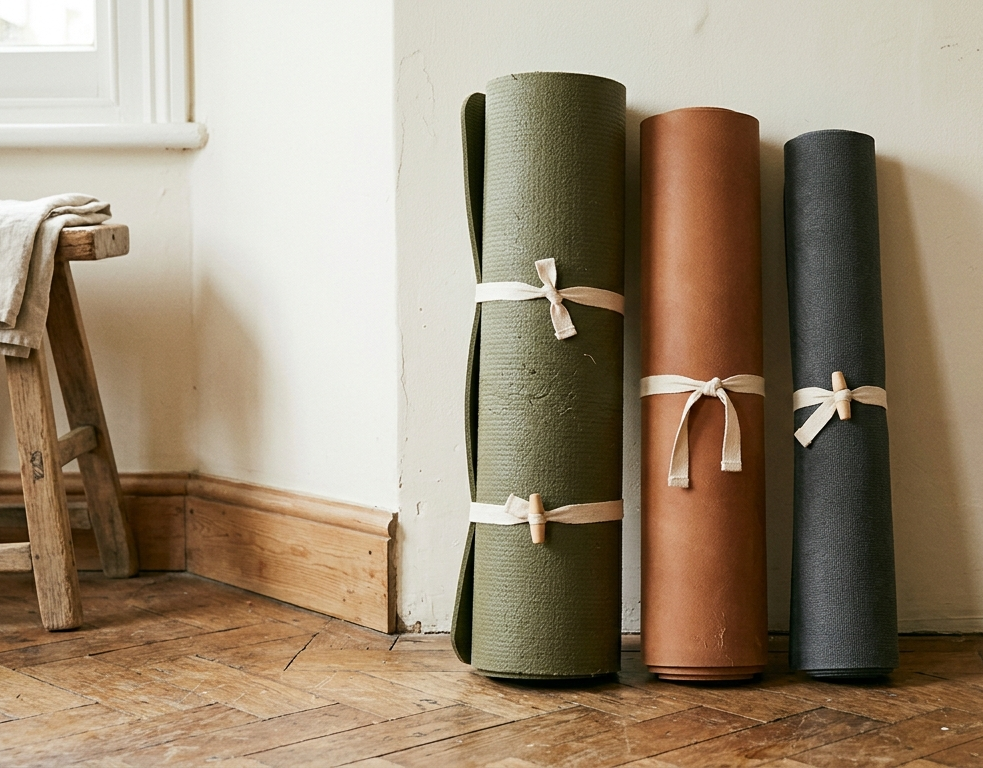
Most retail listings rank mats by colour, brand, or “premium” claims. The number that actually matters first is thickness. A standard yoga mat is around three millimetres; a general fitness mat is around six; a thicker exercise mat for kneeling work is closer to twelve. In my experience, twelve millimetres is the friend of anyone over forty whose knees have started filing complaints.
Thicker is not universally better. A very thick mat is unstable for balance work, and the farther your foot sits from the floor, the more your stabilising muscles have to negotiate. If most of your routine is balance-led — standing flows, single-leg work — lean thinner. If your routine is floor-led, lean thicker.
2. Material: What You Are Sweating On
The honest dividing line in materials is between cheap PVC and almost everything else. PVC mats are inexpensive and durable, but they are dense and not always pleasant against bare skin. TPE mats are lighter, softer, and easier to roll up. Natural rubber mats are the heaviest of the common options and the grippiest, particularly when the room is warm.
“The mat is rarely the bottleneck in a routine; the room around it usually is,” a community-centre movement instructor in Hamilton once told me, and I have repeated it since.
3. Grip: The Single Most Underrated Feature
A mat that slides on hardwood is a mat that lives in a cupboard. The cheapest test you can run before purchase is to lay your hand flat on the rolled mat and try to slide it forward. If your palm and the surface separate easily, you will have the same conversation with your hands and feet during a plank. Grip varies wildly by material and by texture. Natural rubber wins this category in nearly every comparison I have done at home.
Do
- Lay the mat flat in its eventual home for forty-eight hours before judging it.
- Wipe it down weekly with a soft cloth and warm water.
- Store it flat or loosely rolled, never tightly bent.
- Buy a mat sized for your tallest pose, not your average pose.
- Replace when the surface starts to flake; do not nurse a dying mat.
Don’t
- Choose by colour alone.
- Trust a thickness number without standing on it first.
- Use household chemical cleaners on natural rubber.
- Roll the mat the same way every time; alternate directions to keep it flat.
- Buy something so heavy you will never carry it anywhere again.
4. Size: Bigger Than You Think You Need
Standard mats are 173 by 61 centimetres. Most of us are taller, in some direction, than that number assumes. If your fingertips touch the floor beyond the edge of the mat in a forward reach, the mat is too short. I have spent years adjusting myself around small mats. A taller mat — 183 or 200 centimetres — is a small luxury that generally promotes the sense that the practice fits the body, rather than the body apologising to the practice.
5. Weight and Portability
If your mat lives in a single corner of a single home, weight does not matter much. If you plan to carry it to a park, a friend’s living room, or a class, weight matters quite a lot. Natural rubber mats are gloriously grippy and unpleasantly heavy. TPE mats are lighter and happy travellers. According to a small informal survey of our newsletter readers in 2026, the mats most often abandoned in closets are heavy natural-rubber ones bought with travel in mind.
6. Surface Under the Mat
This is the question almost no shopping guide asks. The floor under your mat is half of the equation. A mat on a carpet behaves differently from a mat on a hardwood floor, and a mat on a tile bathroom floor behaves like nothing on earth. If your floor is soft, you can go thinner. If your floor is unforgiving, lean thicker. In my own home, an old hardwood floor with a gentle rug beneath the mat strikes the most comfortable balance.
7. A Note on Budget
You do not need to spend a great deal. In my experience the difference between the cheapest mat in a sporting-goods shop and a thoughtfully chosen middle-priced one is enormous. The difference between a middle-priced one and a premium one is small. Spend up to the point where thickness, material, and grip are honest. Then stop.
Frequently Asked
How long does a good mat last?
With weekly cleaning and respectful storage, a mid-range TPE or natural rubber mat generally lasts three to five years of regular home use.
Are foldable mats worth it?
For travel yes; for daily home use, no. The crease lines tend to lift slightly even after long flat storage.
Does colour matter?
Lighter mats show wear faster but are easier to spot dirt on. In my experience, mid-tones are the most forgiving.
What thickness for older knees?
For floor-based work and kneeling drills, around twelve millimetres is generous and forgiving. For standing flows, around six is more stable.
Need Help Choosing? Book a Free Consultation
We will spend twenty minutes with you on the phone, asking the awkward questions that retailers won’t.
Free consultation with an expertSubscribe to the Gazette
One short letter, every Saturday morning.
Read Also
How to Warm Up During Phone Calls
Quiet drills you can do without anyone knowing.
How to Talk Yourself Into Exercising at Home
The small psychological tricks that keep a routine alive.
Seven Days of Plank: A Diary
An honest week-long log of attempting a daily plank.